Today's great idea for teaching is - you guessed it! - four inch photos. In this classroom Ms. L. included each child's name on the word wall and with each name a four inch head shot of the student. I think this is a great way for students to feel ownership of the classroom and as a guest teacher it has been very helpful in learning names quickly. I think that I would make this a separate bulletin board in older grades (not part of the word wall), perhaps part of a hopes and dreams bulletin board, but still post pictures and names prominently.
Monday, November 19, 2012
Four Inch Photos
Hello all! Today I am back in my favorite kindergarten classroom (let's call
them Ms. L's class). I have had the pleasure of working with this group about 5
or 6 times so far this year. The best way to describe Ms. L's class as a whole
would be joyful. (School starts in about 15 minutes so we'll have to see if I
feel the same way about them at the end of the day!)
Today's great idea for teaching is - you guessed it! - four inch photos. In this classroom Ms. L. included each child's name on the word wall and with each name a four inch head shot of the student. I think this is a great way for students to feel ownership of the classroom and as a guest teacher it has been very helpful in learning names quickly. I think that I would make this a separate bulletin board in older grades (not part of the word wall), perhaps part of a hopes and dreams bulletin board, but still post pictures and names prominently.
Friday, November 16, 2012
Ketchup and Relish
As a guest teacher, I got the rare privilege of teaching in the same classroom two days in a row. Back in the 7th grade science class, our lunch period was switched with 6th grade's lunch and this was where I got today's great idea for teaching. The 6th grade needed more time in the morning for "Ketchup and Relish Day." It is two weeks before the end of the trimester. Students who had all there homework for the trimester complete got to "relish" the day by watching a movie and eating popcorn. Students who had outstanding homework had to "ketchup." While I've seen variations of this played out many times, this version wins the prize for best name for the reward day. What a great way to motivate students!

Images from http://clipart-for-free.blogspot.com and http://www.clker.com
Thursday, November 15, 2012
Seating Chart
Today's great idea for my classroom comes from a 7th grade science teacher. She has 27 to 37 students in each of her 5 classes (in on class there were 5 at a table). When I came into the classroom I found this teacher had a great way of having multiple seating charts. Each students name was on the sticky part of a post-it note and each seating chart was inside a page protector. I think this would work great even for a general classroom teacher - it seems potentially easier to rearrange a seating chart.
Wednesday, November 14, 2012
Guest Teacher
This fall I have been guest teaching. I have been trying to note things that I want to do in my next classroom and I am realizing that it will be beneficial to actually note them (not just think - wow, good idea - and move on). So today's note: The Sub-Folder.
Every teacher creates one. As a guest teacher, it seems that every time I am frustrated because the teacher did not leave the information I needed, it turns out that it actually was there. It (whatever it is) was buried in the sub folder. The key seems to be how that information is organized.
When a sub folder is literally a flat folder it is difficult to find things quickly. When a student is having a melt down and needs to talk to the social worker, I want to be able to act. I do not want to spend time sifting through papers looking for the correct number.
My favorite sub-folder has been a three ringed binder. All the pages were in page protectors and the sections were divided with clearly tabbed tabbed dividers. I want every classroom I substitute teach in to have a binder with the following sections: class list, a list of special needs, seating chart, important phone numbers, daily schedule, and extra activities. Teachers would get bonus points from me if their sub binder included small pictures of each student with the class list or seating chart. I also want the daily schedule to be very specific about morning routines and end of the day routines.
This flip chart from http://thesilverlininginteaching.blogspot.com has very similar information in another easy to use format.
Monday, October 17, 2011
Improving Discussions
At Eagle Bluff I continued to learn and grow as an educator. As a fellowship naturalist, I took a couple of graduate classes through Hamline University which helped focus my learning. Among other things, I greatly improved my group facilitation skills and debriefing skills for adventure education classes. For this assignment I planned questions I could ask students that would help facilitate deeper levels of conversation related to Eagle Bluff's Cross-Country Skiing class. The concepts I focused on where taken directly from the class teaching objectives.
|
Concepts
|
Knowledge/ Comprehension
|
Application
|
Analysis
|
Synthesis
|
Evaluation
|
|
Cross-country skiing was practiced thousands of years ago as a form
of transportation and continues to be popular today.
|
Describe the history of cross-country skiing and how we use it today.
|
Summarize how skiing has been important to different groups of
people.
|
Compare how skiing was done 1000 years ago to how it is done
today.
|
Hypothesize why skiing was important for people thousands of years
ago.
|
Evaluate skiing as a form of transportation.
|
|
Cross-country skiing requires specific knowledge and skills, but can
be enjoyed by people of nearly all ages and ability levels.
|
Explain how people of different abilities can enjoy skiing.
|
Summarize the skills you used skiing today.
|
Compare how skiing might be different for someone who is very old and
someone who is very young.
|
What if we started skiing with no instruction?
|
Evaluate how you feel now on your skies compared with how you felt at
the beginning of class.
|
|
Practicing outdoor recreation promotes good heath and respect for the
natural world.
|
Give examples of how you were respectful towards yourself and the
environment today.
|
How can you model respect outsides of eagle bluff?
|
Relate spending time having fun outside to taking care of the natural
world – can one lead to the other?
|
Predict what would happen if you went skiing with your family when
you get home.
|
Interpret why Eagle Bluff encourages students to learn skills like
cross country skiing.
|
Welcome to Eagle Bluff
Last Year: Eagle Bluff
I would like to present the 2010-2011 school year fellowship naturalists of Eagle Bluff Environmental Learning Center (I am top row, one from the right). We taught environmental science education, adventure education and living history classes to primarily 4th through 8th grade students.
Typically, we welcomed new students on Mondays and Wednesdays. One naturalist was assigned to each group as liaison, or sight host. The rest of the naturalist ran the educational programs. There will be more up-dates to follow about the different classes we taught.
The 12 naturalists lived on campus in the Nat's Wing of the dorms. Here (from left to right) Patrick, Sarina and Creal are relaxing in the kitchen of the Nat Wing.
Friday, October 7, 2011
Base Camp
Happy Fall!
I have been spending a wonderful fall in the twin cities and it has been busy. Recently, I've been teaching swimming lessons, substitute teaching and guiding at the Boy Scouts' Base Camp.
Base Camp is a wonderful place for me to be working. We work mostly with upper elementary and middle school students, however adult work groups often come to work on team building, base camp hosts award ceremonies and speakers, and of course boy scout groups come to Base Camp. I have been teaching many adventure education classes that I first learned to teach at Eagle Bluff including Rock Climbing, High Ropes Course, Archery and Team Challenges. All of these exciting classes ask students to challenge themselves, trust others and grow as individuals.
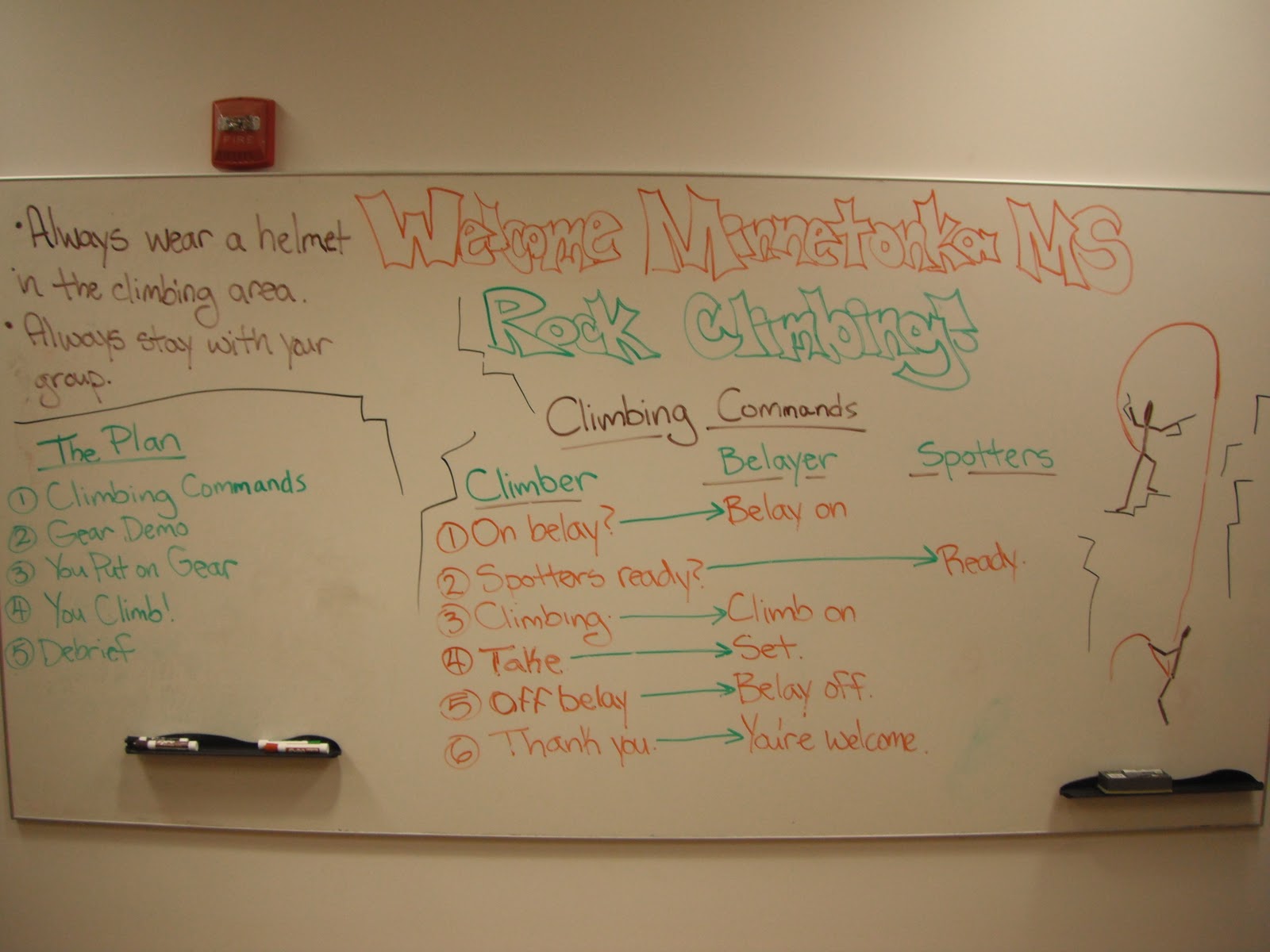
I was recently asked to create a white board to help facilitate the introduction to our Rock Climbing class. As I was creating this I directly used techniques I learned at Eagle Bluff. I focused on the key points and safety rules important to rock climbing. I included the plan for the day, both to help the instructors stay focused and to help participants understand what needs to happen before they can climb. My white board set up is going to be the new standard for what a classroom set up looks like at Base Camp.
When school groups come to Base Camp and go rock climbing guides belay while students climb and spot each other. Here I am belaying:
At Base Camp we practice challenge by choice. I tell students this means they have to challenge themselves but they get to pick what that challenge is. At the rock wall, some people are challenged by getting both feet off the floor, many go about half way up, and some make it to the top of the wall. No matter what their original goal was, I always focus on how far the students made it, how they challenged themselves and how proud of themselves they should be. Having this focus helps all students feel successful and have fun.
10:00 - 10:15 Welcome the whole group and play a game with the whole group
10:15 - 11:15 Team building (now split into smaller groups for the rest of the day and I stay with one group)
11:15 - 12:15 Rock Climbing
12:15 - 12:45 Lunch
12:45 - 1:30 Rock Climbing
1:30 - 2:15 Capture the Flag (combining two small groups)
2:15 - 3:05 Archery
3:05 - 3:15 Reflection/ Send-off
Have I sparked your interest in Base Camp? Check out the web site:
Subscribe to:
Posts (Atom)